UM Transformation, Step 2: Building a Strong Business Case for Insourcing Prior Authorization
1.20.2026
 Share this post
 Share this post
The Centers for Medicare & Medicaid Services (CMS) Interoperability and Prior Authorization Final Rule (CMS‑0057) is one catalyst behind Utilization Management (UM) transformation. The “Status-Quo” of relying on slow manual processes and opaque technology is no longer enough. Health plans must deliver timely Prior Authorization (PA) decisions, expose PA status through APIs, and maintain auditable transparency across every transaction. At the same time, cost pressures and the rapid growth of AI as well as AHIP commitments are pushing payers to rethink delegation strategies that foster high vendor fees, compliance risks, and slow response times.
These tailwinds are prompting payers to bring PA workflows back in-house to regain control, improve efficiency, and help meet CMS-0057 compliance. When paired with the right technology, this shift delivers benefits far beyond checking a compliance box. That’s because interoperability and AI-automation don’t just help health plans meet regulatory requirements; they make operations faster and smarter.
In this blog, we outline steps to build a business case for insourcing PA that balances financial, operational, and regulatory goals and why taking a clinical-first, tech-driven approach can make the numbers add up in your favor.
Every business case needs benchmark data. Begin by asking the tough question: What is our current UM model really costing us? Think of this as the first step of setting the stage for why bringing PA workflows in-house is a strategic necessity. This includes analyzing vendor invoices and digging into other expenses like appeals, care delays, and the operational burden of manual processes. Make sure to record current turnaround times, digital submission rates, provider complaints, and report gaps that could expose your health plan to CMS-0057 compliance risks.
Bringing PA workflows in-house is a redesign of how PA decisions happen. That’s why technology isn’t optional; it’s the lever that lets your UM team absorb the workload without inflating headcount. All while keeping compliance tight and turnaround times fast.
Before you move forward, it’s critical to account for the technology investment required to support this shift. That means determining which PA cases should be brought in-house and which are better left delegated. This clarity ensures you size your technology solution appropriately and avoid unnecessary costs.
What should the right technology deliver?
These capabilities make CMS0057 compliance achievable and ‑turn insourcing PA into a strategic advantage with faster decisions, real-time status, and clean audit trails.
Once you’ve mapped your costs, it’s time to show the math. Start by asking: If we insource, what changes, and what does that mean in dollars? Compare vendor fees to projected internal staffing costs, then layer in automation benefits like reduced manual reviews and fewer appeals.
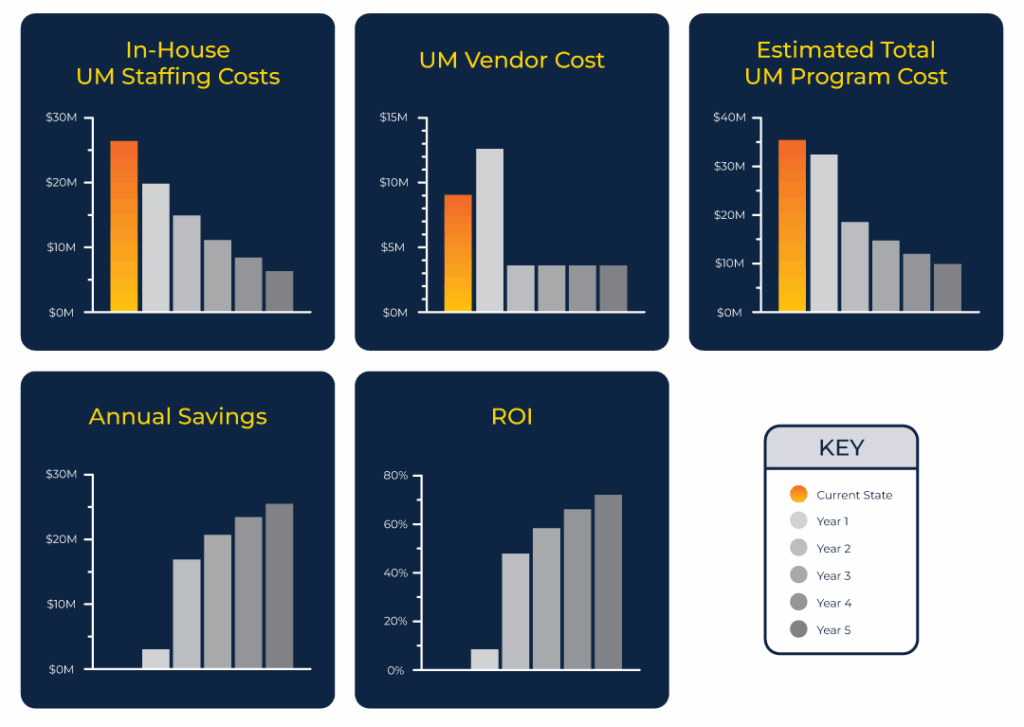
Don’t stop at Year 1. Build a five-year view that captures compounding gains. For example, many plans see ROI climb from 8.5% in Year 1 to over 70% by Year 5 as automation scales and workflows stabilize. Use claims data and actuarial analysis to make this real, because executives respond to hard numbers, not hypotheticals.
Use the graph below to help showcase what a phased ROI model could look like.*
Insourcing PA workflows isn’t just a technology upgrade; it’s an organizational transformation. Even the best financial model and automation plan will fall short without strong stakeholder alignment and a clear path forward.
Start with these actions:
Change management isn’t optional. It’s the bridge between strategy and execution. When everyone understands the vision and the plan, adoption accelerates, resistance fades, and ROI becomes achievable.
Insourcing prior authorizations is more than a compliance play; it’s a strategic reset. CMS-0057 has raised the bar for speed, transparency, and interoperability, and health plans that treat this as an opportunity for change will lead the market.
The business case is clear: build a foundation for scalable, AI automation to reclaim control over PA workflows to deliver long-term measurable ROI. But building that case requires more than good intentions. It demands a structured approach backed by data, governance, and the right technology choices.
If you’re ready to move from concept to execution, start with the right blueprint. Our Blueprint for UM Transformation distills best practices, ROI models, and phased implementation steps to help you make the case, and make it stick.
DOWNLOAD BLUEPRINT
Share this post
*This graph represents a projected financial model developed for a large, national health plan transitioning from fully delegated UM to a hybrid insourced approach.