UM Transformation, Step 1: What to Insource vs. Delegate
1.12.2026
 Share this post
 Share this post
Prior Authorizations (PA), a core function of Utilization Management (UM), was created to protect patients from unnecessary procedures and help manage medical costs. Over time, PA has evolved into a complex, abrasive process with manual workflows, high administrative burden, and fragmented technology systems.
Because of its complexity, many health plans made the decision to outsource aspects of UM, including PAs, to delegated vendors. The ability to scale and simplify in-house operations seemed like a logical choice. However, it became clear that outsourcing PA workflows came with its fair share of drawbacks. Such as inconsistent determinations and reduced transparency. This led to care delays and compliance risks that could impact both reputation and financial performance.
Now, with the landmark Centers for Medicare & Medicaid Services (CMS)-0057 Final Rule raising expectations for PA speed, transparency, and interoperability, health plans are under new pressure to transform UM. The Final Rule isn’t just about compliance. It’s an opportunity to take control of patient care by bringing core PA processes back in-house, building a foundation for better outcomes.
This is the first blog in a three-part series on transforming UM. In this opening blog post, we’ll focus on how to decide what to insource versus delegate, a critical first step in building a modern UM strategy. Future posts will dive into:
Stay tuned as we guide you through each stage of UM transformation.
For Directors and VPs of UM, the challenge isn’t choosing between full delegation or complete insourcing; it’s finding the right balance. Delegating all responsibilities to a third party can diminish visibility and control, while assuming every function internally can strain resources and limit agility.
The most effective leaders adopt a hybrid approach: insourcing core functions to maintain oversight and accountability, while outsourcing complex specialties to preserve flexibility without compromising quality.
The first step in this transition is identifying which PA cases should remain in-house and which are better suited for a delegated vendor. To make these decisions with confidence, executives need an objective, actionable framework. That’s where the Volume/Value Framework becomes essential.
Start by categorizing PA services based on volume (how often they occur) and value (clinical complexity and cost). This framework helps you prioritize resources and determine the most effective approach for each category:
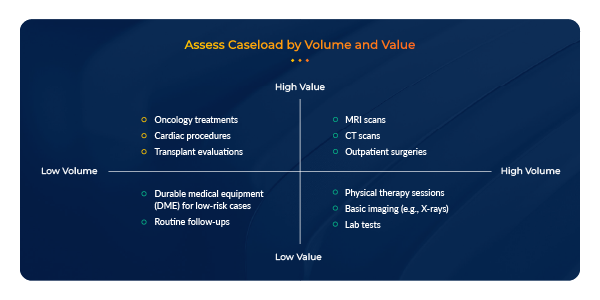
When it comes to utilization management, oncology is a prime example of why a hybrid approach makes sense. Cases like chemotherapy, radiation therapy, transplant evaluations are low in volume but high in value, requiring subspecialty expertise that most health plans can’t fully support in-house.
Completely delegating these services can erode oversight, while trying to manage them internally can strain resources. The sweet spot? Delegate clinical review to trusted vendors while maintaining control through internal tools for documentation and auditing. This approach ensures compliance, preserves visibility, and keeps care moving without unnecessary delays.
Tool Strategy for Success:
By applying the Volume/Value Framework, health plans can confidently decide where to insource and where to delegate to create a model that’s both efficient and clinically sound.
With CMS‑0057 raising expectations for speed, transparency, and interoperability, health plans must be far more intentional about what to bring in-house and what to continue delegating.
The challenge isn’t whether to insource, it’s knowing where to start. Which PA use cases make sense to insource first? Which are better left delegated? And how do you sequence those decisions without disrupting operations or provider relationships?
Our Blueprint for UM Transformation walks through a clear, step-by-step framework for answering those questions. It outlines how to evaluate PA volume, complexity, and clinical risk, provides concrete examples of common insourcing scenarios, and shows how leading plans are phasing the transition over time.
If you’re ready to move from high-level intent to informed execution, start with a blueprint built for real-world UM decisions.
DOWNLOAD BLUEPRINT
Share this post